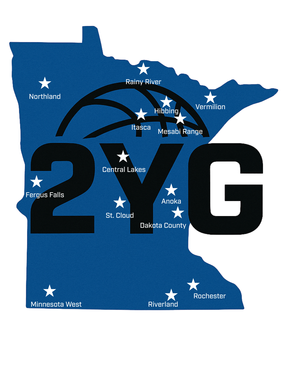
Small gyms. A whole lot of national hardware. Minnesota JUCO women’s basketball deserves more than a passing mention. Let’s give it the attention it’s earned.
MINNESOTA OWNS JUCO WOMEN'S BASKETBALL
Four straight NJCAA Division III national champions. Four straight National Player of the Year awards. The results are clear. The more interesting question is what keeps producing them.
By Anthony Brant
At some point, calling this a nice run starts to sound ridiculous.
RCTC won the NJCAA Division III women's national championship in 2023. Minnesota West won it in 2024. Rochester took it back in 2025. Minnesota West won it again in 2026.
Apparently the trophy has a Minnesota address now.
And in 2026, the state didn't stop at first place. Anoka-Ramsey finished second and Northland finished third. Three Minnesota teams occupied the whole damn podium.
The season recap gets into how they did it. This article is about the part that extends beyond one tournament: why does this keep happening here?
FIRST, LOOK AT THE FOUR-YEAR RUN
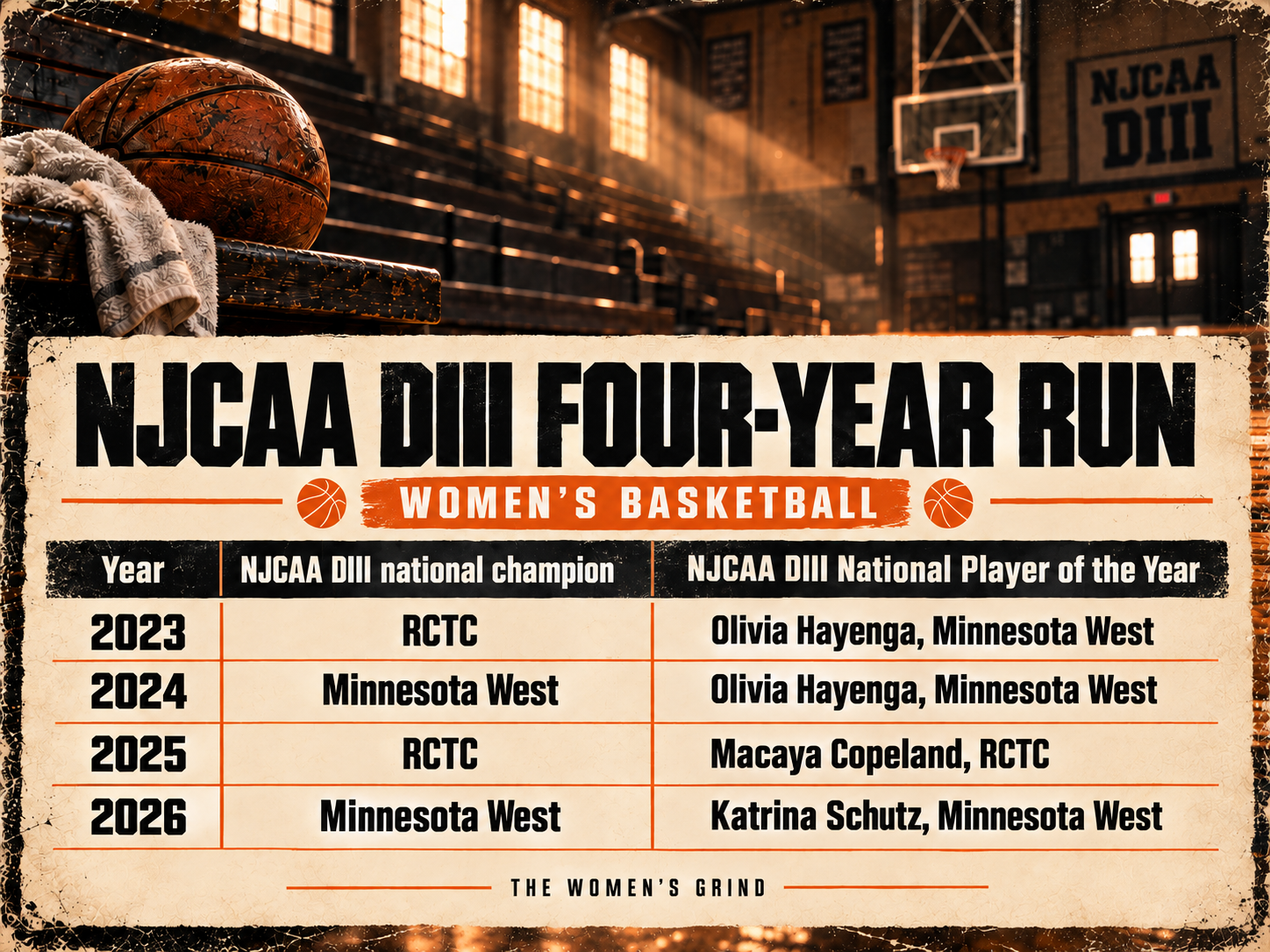
Four championships. Four top individual awards.
That's enough hardware that somebody should probably check whether the shelf is anchored correctly.
And it wasn't always one Minnesota team making the trip while everybody else stayed home. RCTC and Minnesota West met in the 2023 and 2024 championship games. Minnesota West and Anoka-Ramsey met in the 2026 final.
Northland finished third in both 2024 and 2026.
We're talking specifically about NJCAA Division III, not declaring that Minnesota has conquered every division of junior college basketball. But within that competition, these programs have earned the right to make a little noise.
Or a lot.
THE COACHES ARE A GOOD PLACE TO START
My first explanation is continuity.
Shannon Nelson has led Northland since 2010. The Pioneers won a national championship in 2014, and they were still finishing on the national podium more than a decade later.
That's different groups of players succeeding in the same program over time.
At Minnesota West, Rosalie "Moz" Hayenga-Hostikka's connection goes back to her own playing days. She helped the school win a state championship in 1992 before eventually returning to coach. The 2026 national title was the program's second in three seasons under her.
There's something pretty cool about a former player coming back and building that.
In JUCO, a coach doesn't get to keep a championship lineup together indefinitely. Players finish, transfer or take the next step in their lives. The next group still needs to learn what the program expects.
My read is that having experienced people carry those expectations from team to team gives you something valuable. It's where I'd start asking questions, not a claim that I've discovered the one secret behind every Minnesota win.
THE TALENT DOESN'T ALL LEAVE THE STATE
The next place I'd look is the local player pool.
Jason Bonde described RCTC's 2023 championship team as being built largely with players from within roughly an hour of Rochester. Katrina Schutz, Minnesota West's 2026 National Player of the Year, came from Eden Valley.
Copeland came from Hopkins, where she developed a defensive role before taking on much more responsibility at RCTC.
Different players. Different circumstances. Real opportunities sitting within Minnesota.
I don't need to claim every player was overlooked by every bigger school to appreciate that. Sometimes a player needs a larger role. Sometimes a particular school fits. Sometimes the opportunity is close to home and that's exactly what makes it possible.
The interesting question for the coaches is how they identify those players and what happens once they arrive.
What did Rochester see in Copeland? What did Minnesota West build around Schutz? What does Northland ask its incoming players to learn before the first game?
That's where an explanation starts to become more useful than "Minnesota girls can hoop."
They can. I'd like to understand the work underneath it.
YOU DON'T HAVE TO WAIT UNTIL NATIONALS TO GET TESTED
Here's another theory: facing good teams close to home helps.
In 2025-26, Minnesota West went unbeaten in the MCAC South, with Anoka-Ramsey finishing second. Those two programs eventually played for the national championship.
Northland and Anoka met in the Region XIII B final. Then they met again in a national semifinal, which Anoka won 57-55.
Imagine traveling to the national tournament and finding the same people standing between you and the championship.
Again.
The scores establish that these teams were encountering national-level competition within their own basketball neighborhood. They don't prove that conference strength single-handedly caused the national results. But they give us a pretty good reason to take those regular-season matchups seriously.
Fans didn't have to wait until March to see teams capable of reaching the last weekend.
They could watch them play each other here.
SUCCESS DOESN'T MAKE THE WHOLE THING PERMANENT
There is a catch to the victory lap.
RCTC won the 2025 championship 73-37, then didn't field a team the following season. The state swept the 2026 podium without the defending champion even playing that winter.
That is both an extraordinary statement about the other programs and a reminder not to mistake trophies for guaranteed stability.
The coaching picture changes too. Bonde left RCTC in April 2026. After taking Anoka-Ramsey to the 2026 national final, Samantha Doucette was announced as Milwaukee Area Technical College's new coach that July.
So "good coaches stay" cannot be the entire explanation. Some do. Others move on, and programs have to carry the work forward.
The MCAC also had difficult seasons well outside the championship picture. Riverland finished 0-21 in 2025-26. Rainy River went 2-21. Those players were participating in the same league, not a different story we can crop out of the celebration.
Minnesota's national success is real. It doesn't mean every program has the same resources, roster depth or experience.
That makes the next season interesting, not predetermined.
LET'S FIND OUT MORE
The results tell us these programs can win at this level. They don't tell us everything about why.
For that, I'd like to hear from the players and coaches. How do they recruit? What keeps someone in the program? What changes between a player's first practice and her last postseason game? What support makes a second season possible?
Those are the questions worth taking into the gym.
In the meantime, we can stop talking about these titles like a cute little surprise. Rochester and Minnesota West have traded the championship for four years. Anoka-Ramsey and Northland have put themselves right in the middle of the national picture too.
Those women did the work. They won the games. The rest of us can learn their names.
Minnesota owns this particular corner of the basketball world right now.
The next team coming for the trophy has been warned.