I TRIED TO BUILD
THE ALL-TIME
MCAC TEAMS
Fifteen men. Fifteen women. Decades of basketball. The hard part isn’t finding great players. It’s making sure the list doesn’t confuse better records with better careers.
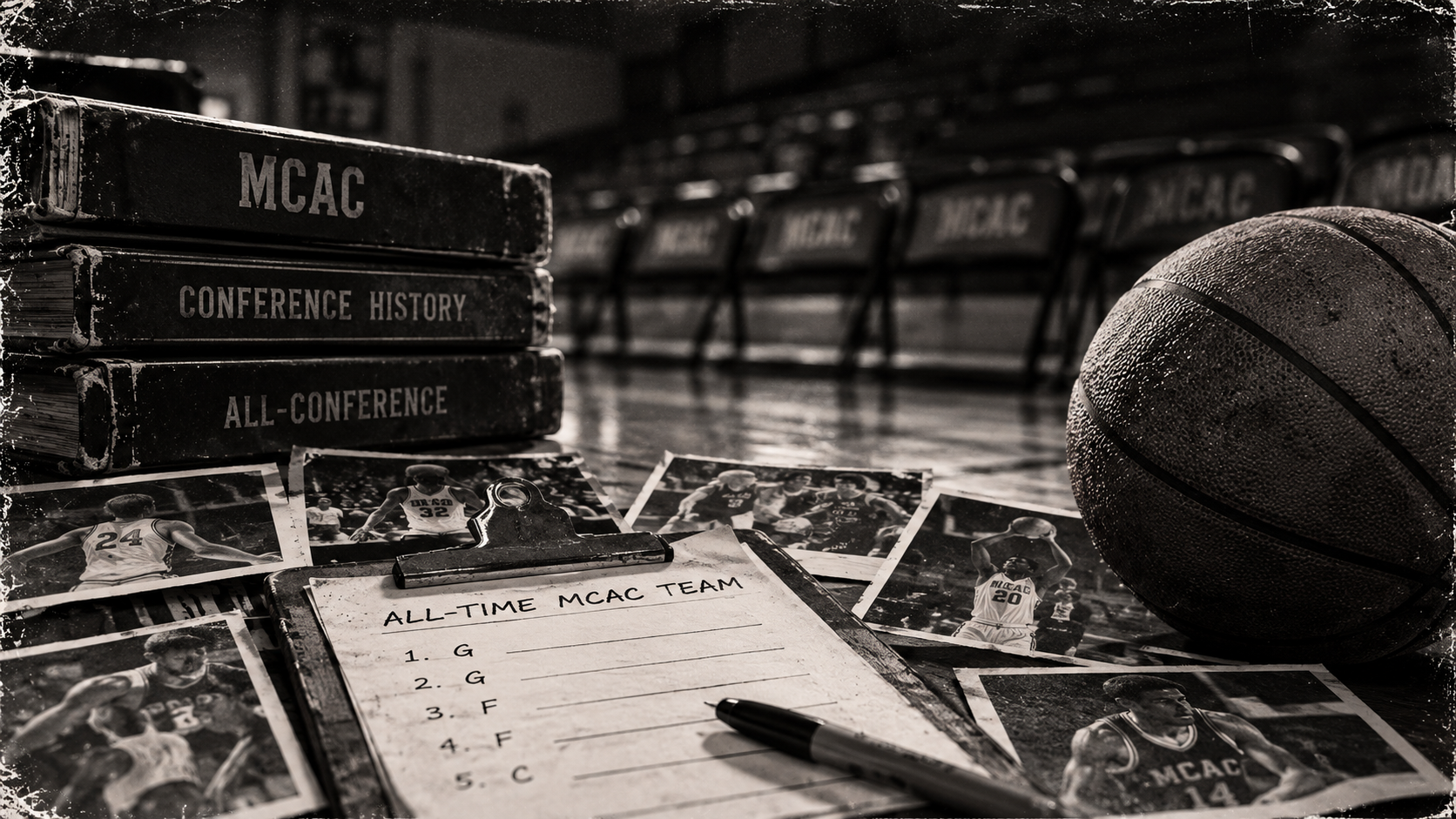
I HAD A SIMPLE IDEA
Build the all-time MCAC basketball teams.
First Team.
Second Team.
Third Team.
Five players each.
Men and women.
Thirty spots.
How hard could that possibly be?
Then I actually started doing it.
And discovered a fairly significant problem:
A recent player might have a complete game log, shooting splits, every award, a highlight package and a four-year college bio sitting two clicks away.
Go back far enough?
You might be lucky to find a roster.
Maybe an old newspaper clipping.
Maybe an All-Conference list somebody scanned fifteen years ago.
Maybe absolutely nothing.
So before I start throwing names onto First Team, we need rules.
Better rules.
FIRST THINGS FIRST: THIS IS AN MCAC LIST
This sounds obvious.
It apparently isn't.
The first thing that matters is what you did in the MCAC.
Not who became the most famous later.
Not who played at the highest level afterward.
Not who has the coolest Wikipedia page.
We're ranking MCAC careers.
That's the job.
If somebody became a Division I player, professional, coach or anything else afterward, that's useful context.
It can tell us the talent was real.
But it cannot erase what actually happened while that player was here.
SO WHAT ACTUALLY COUNTS?
What did the player actually produce while playing in this league?
Conference, regional and national recognition matter.
Team success matters—but only in the context of the player's actual role.
Two great seasons can mean more than one ridiculous semester.
Usage, efficiency, defense and what a player was actually asked to carry all matter.
Numbers have to be understood inside the basketball that produced them.
There's no magic formula.
Sorry.
I know the internet loves turning basketball into a spreadsheet and declaring the argument over.
Not happening here.
THE DATA PROBLEM IS REAL
Here's what makes this project annoying. And interesting.
Recent players are easy.
Relatively.
Stats.
Game logs.
Rosters.
Awards.
National tournament pages.
Sometimes film.
Then you start moving backward.
Things disappear.
Websites change.
Schools merge.
Programs close.
Old statistical databases don't always carry everything with them.
And eventually you run into players whose reputations clearly survived longer than their stat pages did.
That matters.
MISSING DATA IS NOT A BAD SEASON
This is probably the most important rule.
I am not going to punish an older player because the internet failed to preserve his or her box scores.
That's stupid.
A missing stat is not a zero.
A missing award page does not mean the award didn't exist.
A player from 2009 should not automatically lose to a player from 2025 because one has seventeen hyperlinks and the other has a newspaper clipping.
That's not evaluation.
That's rewarding Google.
UNRESOLVED IS NOT HONORABLE MENTION
This part matters too.
If I know a player might belong in this conversation but I don't yet have enough evidence, I'm not going to quietly dump that player into Honorable Mention and pretend the research is finished.
That's not what Honorable Mention is for.
Honorable Mention should mean:
I evaluated your career, and you were damn good.
It should not mean:
I couldn't find your sophomore-year stats.
If the evidence isn't there yet, the player stays unresolved.
And we keep digging.
THE AFTER-JUCO PART MATTERS
Just not as much as some people are going to want it to.
If two players have very similar MCAC résumés and one goes on to play Division I?
That's useful.
If somebody becomes an All-American at the next level?
Useful.
Professional career?
Useful.
It tells us something about the level of player we were watching.
But we're not ranking what happened afterward.
A mediocre MCAC career does not become an all-time MCAC career because somebody later became famous.
WE'RE NOT COMPARING RAW NUMBERS LIKE IDIOTS
Somebody averaged 24 points.
Somebody else averaged 18.
Great.
That does not automatically tell us who had the better season.
Pace changes.
Rules change.
Three-point volume changes.
Teams play differently.
Divisions change.
Competition changes.
Roles change.
One player may have been the entire offensive engine.
Another may have played on a loaded team with four other guys who could score.
Context matters.
The numbers are evidence.
They are not the verdict.
THE WOMEN'S SIDE GETS RIDICULOUS FAST
I knew this project was going to be difficult.
Then I started working through the women's side.
Oh.
Cool.
This is impossible.
Minnesota JUCO women's basketball has produced national champions, national players of the year, All-Americans and ridiculous individual careers.
Which means fifteen spots disappear very quickly.
That's a good problem.
It also means I fully expect people to be furious with me.
Perfect.
That's what comments sections are for.
POSITIONS MATTER. SORT OF.
I'm not building five point guards and calling it a basketball team.
But I'm also not going to pretend basketball positions have stayed perfectly consistent across decades.
Guard.
Wing.
Forward.
Big.
Those distinctions matter.
The exact label?
Less so.
I want each team to resemble something you could actually put on a basketball court.
But I'm not passing over one of the fifteen best careers because somebody's old roster called him a forward instead of a guard-forward.
THE BASIC BALLOT
FOR EVERY CANDIDATE
THE CUTS ARE GOING TO SUCK
That's the other thing I've already learned.
Thirty sounds like a lot.
It isn't.
Fifteen men.
Fifteen women.
Once you start putting real names on the board, those spots disappear immediately.
There are going to be legitimately great MCAC players who do not make the First, Second or Third Team.
That's not disrespect.
That's the assignment.
If everybody makes the list, the list means nothing.
SO HERE'S HOW WE'RE DOING THIS
I'm not dropping thirty names at once and running away.
That's boring.
And more importantly, some of these players deserve more than one sentence next to their statistics.
So we're going backward.
Honorable Mention first.
One player at a time.
Then Third Team.
Second Team.
First Team.
Men and women.
Every selection gets a case.
Every selection gets evidence.
And if better evidence shows up later?
Good.
This is history, not stone tablets.
AND YES, I WANT YOUR HELP
This project gets better if people who actually lived these eras participate.
Coaches.
Players.
Athletic directors.
Parents.
People with old programs sitting in boxes.
If you have stats, awards, rosters, newspaper clippings, photographs or context I'm missing:
send it.
I'm not interested in winning an argument with incomplete information.
I'm interested in getting the damn list right.
SO HERE WE GO
Fifteen men.
Fifteen women.
Three teams each.
Decades of basketball.
Different eras.
Different records.
Different levels of documentation.
And probably several people already preparing to tell me I'm an idiot.
Good.
At least now we have rules.
ABOUT THIS PROJECT
LEGENDS OF THE LEAGUE is 2 Year Grind's ongoing effort to recognize the best men's and women's basketball careers in MCAC history.
Part I establishes the evaluation method. The selections will roll out beginning with Honorable Mention before moving through Third Team, Second Team and First Team.
Historical records remain incomplete for some eras. New documentation, verified statistics and firsthand context may be incorporated as the research continues.