
PAUL McDONALD
TAUGHT ME
THE WORK
He taught me to attack, stop making excuses and understand that talent only matters if you’re willing to work for it. Nearly two decades later, I finally understand the lesson.
THE JORDAN JUMPSUIT
I still remember seeing Paul McDonald for the first time.
I had just pulled into Vermilion.
Ely.
Summer.
Beautiful.
Rural as hell.
I don't know exactly what I expected my junior-college basketball coach to look like.
Maybe some northern Minnesota version of Yosemite Sam.
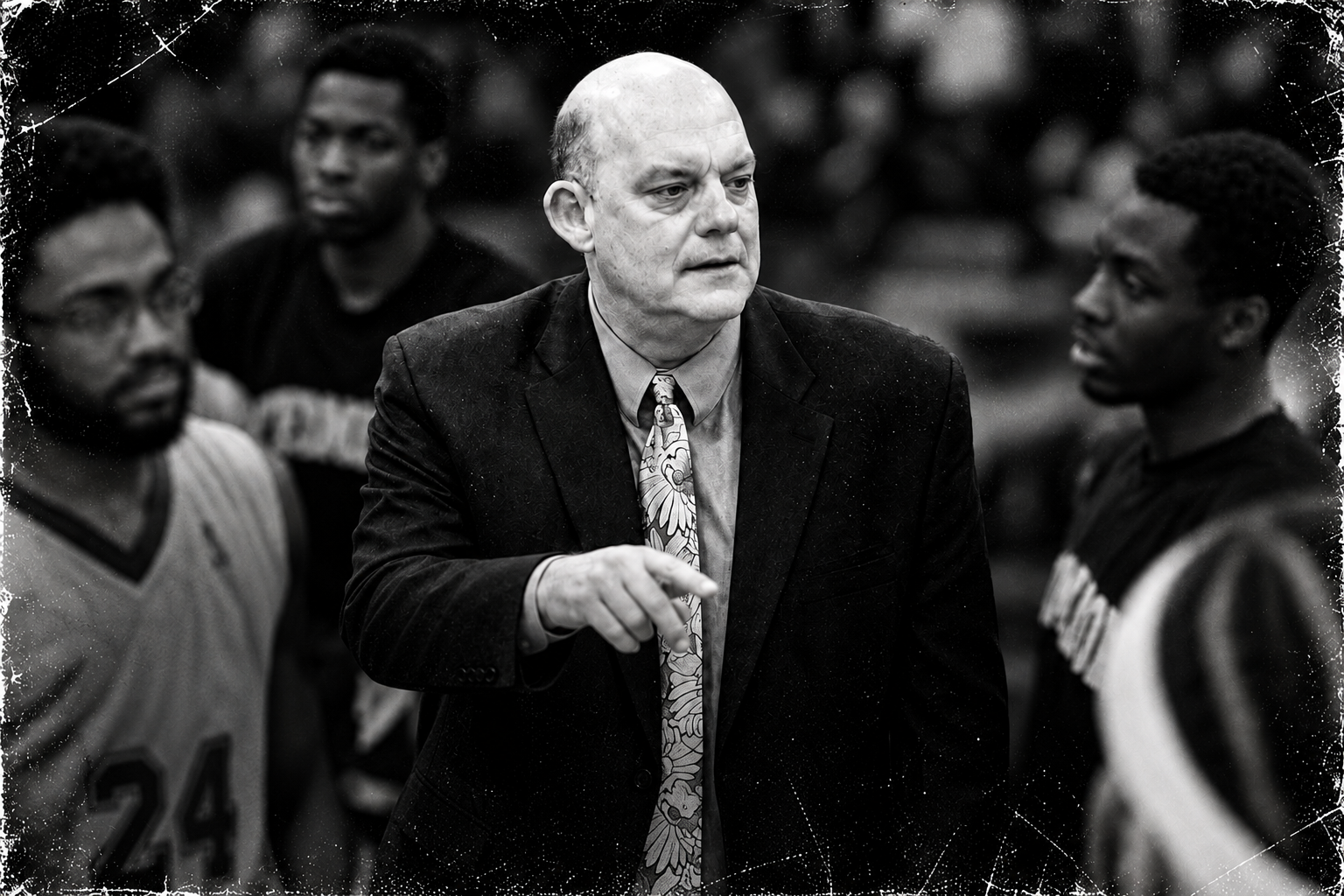
Instead, standing in front of the school was this very tall, bald white guy absolutely dripped out in a black-and-white Jordan jumpsuit.
Jordan shoes too.
Big grin.
Looked a little like Uncle Fester.
Christopher Lloyd version, obviously.
Then he started talking.
Smooth as silk.
Confident.
Like I hadn't arrived at a college.
I had entered his town.
My first thought was basically:
Two years later, I can confirm:
he did not disappoint.
PAUL DIDN'T REALLY NEED TO RECRUIT ME
By 2008, Paul McDonald was established enough that recruiting didn't always look like recruiting.
He had pipelines.
Coaches knew him.
Programs trusted him.
Players had already gone through Vermilion, moved on and shown people what the place could do.
My high-school coach knew Paul.
Players from Tartan had gone to Vermilion before me and had success there.
I was deciding between Division III and junior college.
My coach basically told me:
this is the spot.
Sometimes recruiting is a sales pitch.
Sometimes the program's reputation already made the pitch for you.
OH. THIS DUDE CAN COACH.
I don't remember some magical first drill that convinced me Paul knew basketball.
I remember watching him talk to the returning players.
And watching them listen.
Really listen.
You learn pretty quickly which coaches have the room.
He had it.
He could be funny.
He could crack on an assistant coach.
Tell stories about his own playing days.
Have everybody dying laughing.
But when practice started?
Different deal.
Paul did not fuck around.
THEN HE TAUGHT ME THE WORK
This is the biggest thing Paul gave me.
Not a play.
Not a shooting drill.
Not some secret defensive coverage.
He taught me what the work actually looked like.
I thought I worked hard before college.
And to be fair, I did work.
In high school, I used to drive in early before classes to shoot.
I did it often enough that my coach eventually convinced maintenance to lower a hoop every morning at 6 a.m. so he wouldn't have to keep doing it himself.
That's work.
But nobody was really watching it.
Tracking it.
Critiquing it.
Building the session around a purpose.
Then I got to Vermilion.
Paul lived for that shit.
MY FIRST WORKOUT WITH HIM
I thought I was going to die.
Not pass out.
Die.
Actual final moments.
I'm bent over, breathing like somebody stole half my lungs, seeing stars, reconsidering every decision that brought me to Ely.
I look over.
Paul is smiling.
And he says:
Again?
My man.
This ain't Miracle on Ice.
If we go again, this may literally be my final scene.
We went again.
That's when I started understanding what high-level work actually felt like.
The limit I thought I had wasn't really the limit.
It was just the place where I had previously decided to stop.
PAUL McDONALD PRACTICE
Fast.
Chaotic.
Structured.
Competitive.
Exhausting.
Somehow all at once.
The players demanded the pace.
I was used to horses.
Vermilion had some thoroughbreds.
We wanted controlled chaos.
But don't confuse chaos with not having a plan.
In two years, I never walked out of a practice thinking Paul had just winged it.
Every day had a purpose.
Every rep had competition.
And at JUCO, every player understood the truth:
if you take a day off, somebody else wants your minutes.
ATTACK
If I had to boil Paul McDonald basketball down to one word:
Forward.
Always.
Get the ball?
Push it.
Make something happen.
Collapse the defense.
Play out of it.
Forget that four-corners bullshit.
Go.
If you weren't attacking, there was a very comfortable place available for you.
The bench.
He coached basketball players.
Not robots memorizing forty different offensive sets.
We had actions.
We had plays.
But mostly we were expected to read basketball.
And if you defended the way he expected?
You got freedom offensively.
WHAT HE HATED
Lazy basketball.
Lazy passes.
Lazy defense.
Carelessness with the ball.
When you have a bench full of players willing to give everything they have, you can't tolerate somebody giving half.
But if you really wanted to push the button?
Make an excuse.
Start explaining why something wasn't your fault.
Talk back with some weak-ass reason for why you didn't do what you were supposed to do.
That was the button.
And once you hit it?
Good luck.
I HIT THE FUCKING SHOT CLOCK
I remember one practice where the team I was on lost something.
Scrimmage.
Drill.
Doesn't matter.
I was pissed.
So I threw the basketball across the court.
Great mature decision.
The ball hit the shot clock.
Silence.
Here's something I did not fully appreciate at the time:
JUCO programs do not have an unlimited shot-clock replacement budget.
Paul knew that.
Thank God I didn't break it.
Didn't save us.
Everybody got on the line.
Not just me.
Everybody.
And we ran until we damn near passed out.
I offered to take the punishment alone.
Too late.
The looks my teammates gave me during that near-death conditioning session are permanently stored in my brain.
Lesson learned.
I never threw another basketball across practice.
Funny how that works.
THEN HE TOLD ME TO SHOOT THE DAMN BALL
My senior year of high school, I led my team in scoring.
Big-time stuff.
Eleven points per game.
Somebody call ESPN.
We had possessions that could last north of two minutes.
I was never trained to think of myself as a high-volume scorer.
Paul saw something different.
He kept telling me:
Simple.
But it changed me.
Once I earned his trust, I got the green light.
And that green light came with responsibility.
I couldn't just do whatever the hell I wanted.
I was allowed to do what was expected of me.
There's a difference.
That confidence opened my game and eventually helped me play beyond junior college.
FAIR DOESN'T MEAN EQUAL
Here's another lesson that took me years to understand.
Paul treated people fairly.
He did not treat everybody equally.
Those are not the same thing.
At nineteen, that is difficult to accept.
Because at nineteen, you are the guy.
In your own head, anyway.
Fuck that other dude.
Why is he playing?
Why does he get away with that?
Why is Coach talking to him differently?
Then you become an adult and realize this is basically how the entire world works.
Different people need different things.
Different roles carry different responsibilities.
The Rock probably said it best:
Know your role.
AND THEN THERE WAS ELY
All respect to Ely, Minnesota.
Great people.
Beautiful place.
But let me say something those people will probably agree with:
It wasn't a race thing.
Nobody cared about that.
We just did not give two shits about most of the reasons people intentionally move to Ely.
Fishing?
Cool.
We had fishing where we came from too.
Hunting culture?
Sweet Jesus.
My first roommate spilled a bottle of fake deer piss in our room.
The smell lasted about a week.
I slept on the couch.
Those couches sucked.
Deer opener made the whole place feel like an army base.
But here's the thing.
All of that brought us together.
We were around each other constantly.
Snowed in.
Hooping.
Talking shit.
Playing one-on-one.
Occasionally taking those games a little too seriously.
We became close because there wasn't really another option.
Paul understood how to build confidence inside that environment.
WINNING BECAME THE EXPECTATION
I didn't know much about Vermilion's history when I got there.
Should I have researched it?
Yes.
Was researching junior-college basketball significantly more annoying in 2008?
Also yes.
See?
That's exactly the kind of excuse Mac would've chewed my ass out for.
I learned what Vermilion meant inside the league pretty quickly.
We lost to Itasca at home my freshman year.
They celebrated like they had just won the league.
And that's when it clicked.
They weren't just beating us.
They were beating Vermilion.
The players before us had created an expectation.
Paul reinforced it.
You walked into games expecting to win.
Not hoping.
Expecting.
THE PIPELINE WAS THE SALES PITCH
How did Paul convince good players to come to Ely?
Pretty simple.
Look where the last guys went.
The list of players who earned scholarships out of Vermilion stretched across the country.
California.
Florida.
Outside the country.
Coaches trusted Paul.
Former players trusted Paul.
High-school coaches trusted Paul.
If he said a player could fit your program, people listened.
Some kids could get opportunities with almost no usable film.
Which sounds impossible now.
Today your parent's iPhone shoots cleaner video than the camcorder we had sitting above the bleachers.
And that's assuming the student volunteer remembered to move the damn camera.
You know there were eight possessions happening completely off-screen.
Guaranteed.
And if the recording worked?
Congratulations.
You got a DVD.
Ancient technology.
Better get to Coach's office early.
He might only have one copy.
What mattered was his word.
BUT THE NEXT LEVEL WASN'T THE REAL GOAL
Paul wanted players to continue playing.
Of course he did.
He loved helping guys find scholarships.
He loved making calls.
Loved finding the right fit.
But if you really want to understand what mattered to him:
I cannot state that strongly enough.
He wanted you to advance your life.
Basketball was part of that.
It wasn't the whole thing.
A lot of players coming through programs like ours were among the first people in their families to go to college.
Paul understood the weight of that.
He'd talk about family.
About what it meant for the people coming after you.
About changing the direction of a family.
He genuinely wanted you to win at life.
Not just win Tuesday night in Brainerd.
HE SHOWED US WHAT MATTERED
Away from basketball, Paul took enormous pride in being a husband and father.
That showed up in how he coached us.
The lesson always came back to people.
Family.
Responsibility.
Becoming somebody the people around you could count on.
That's one of those lessons you hear at nineteen and understand at thirty-seven.
Totally different experience.
THE PART I DIDN'T HANDLE WELL
After I left Vermilion, there were stretches where I didn't talk to Paul much.
And that's on me.
Part of it was life.
Moves.
Basketball.
Work.
Marriage.
Kids.
All the shit that starts stacking up once adulthood gets going.
But part of it was something else.
I didn't want to talk to him unless I had good news.
Progress.
Something impressive to report.
When I was figuring out life— the same life he spent two years warning us was coming— I almost felt ashamed to talk to him.
I wasn't living the life I had looked him in the face and told him I wanted.
So sometimes I stayed away.
That's a strange thing about people who believed in you.
When you're struggling, they can become the exact people you're most afraid to disappoint.
NOW I GET IT
Eventually you grow up.
Hopefully.
You become a husband.
A father.
You get a job.
Build a life.
And some previous versions of yourself get packed away for a little while.
That's normal.
The kids get older.
The marriage gets stronger.
You understand yourself better.
And eventually, the need for the Grind starts showing up again.
That's part of why this website exists.
I'm going back to parts of my basketball life I hadn't really touched in a long time.
And when I do, there is no version of that story without Paul McDonald.
IF I SAW HIM TODAY
I wouldn't lead with basketball.
I wouldn't ask about the offense.
Or the titles.
Or how many players he helped move on.
I'd probably just hug him.
Thank him.
And apologize for being absent longer than I should have been.
Thank you for continuing to believe in me when I didn't always reciprocate it the way I should have.
Thank you for showing me what work actually looked like.
Thank you for giving me confidence before I completely understood what to do with it.
Thank you for taking a chance on me.
It was an honor to be an Ironman.
And Paul...
one last thing.
WITH THIS IRONHAWK THING?
ABOUT THIS PIECE
This story is based primarily on Anthony Brant's personal experience playing for Paul McDonald at Vermilion Community College during the 2008–09 and 2009–10 seasons.
Memories include practices, workouts, recruiting, team culture, player development, life lessons and Anthony's relationship with Coach McDonald during and after Vermilion.
THE CLIPBOARD
2 Year Grind's ongoing series about the coaches
whose influence lasted longer than the games they coached.